The 2026 Specifier Survey
What architects, engineers, ESD consultants, developers and asset owners across Australia and New Zealand actually ask for when they judge a building product's sustainability credentials.
Why this exists
I am often asked by product manufacturers and suppliers: what sustainability information do specifiers expect today?
It is a hard question, because there is a gap between what the people who choose building products ask for and what the people who make them spend their money on proving, and neither side can see across it clearly. So rather than keep inferring, I asked.
I have contacted over 150 architects, engineers, ESD and sustainability consultants, developers, asset owners and government clients across Australia and New Zealand. Nine questions, three minutes. So far close to one in five have answered.
The survey stays open, and these findings are updated as responses come in. Treat what follows as a first read rather than a market measurement.
Take part
Everyone who answers gets each write-up before it goes anywhere else.
Specifiers If you select or approve building products Nine questions, about three minutes. Architects, engineers, ESD and sustainability consultants, developers, asset owners, government. Manufacturers and suppliers If you make or supply building products The same study from the other side of the table. Ten questions on where you stand, none on what you hold.Findings so far
Verified data is expected
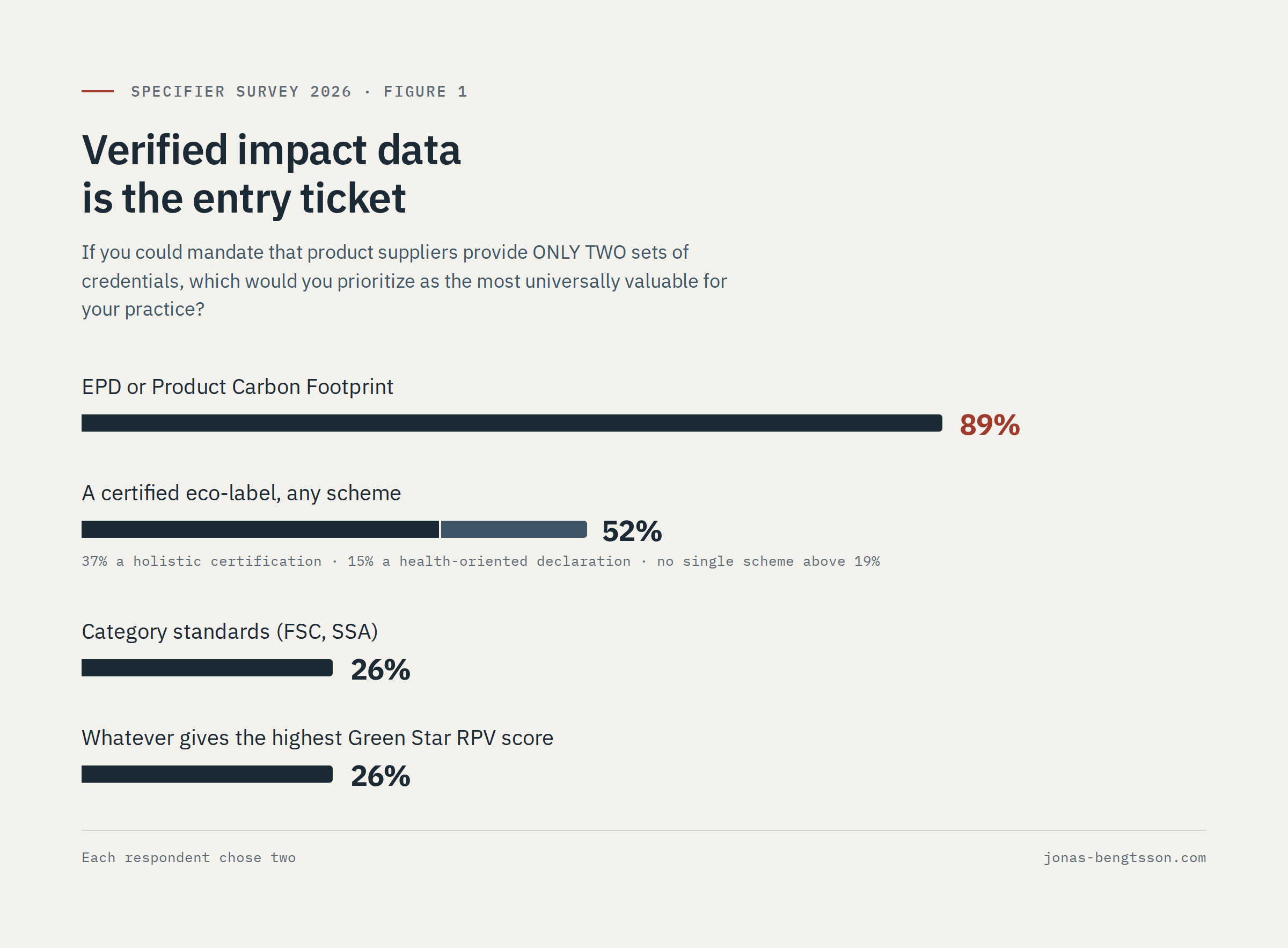
Asked to require only two sets of credentials from a supplier, 89% picked an Environmental Product Declaration (EPD) or a Product Carbon Footprint (PCF). No individual eco-label came close on its own. Grouped, the holistic certifications reach 37%, and any certified label reaches 52%. No individual scheme sits above 19%.
Specifiers want a label, but they do not agree on which one, and that is harder for a manufacturer to plan for than the carbon data.
The RPV score has not become the yardstick yet
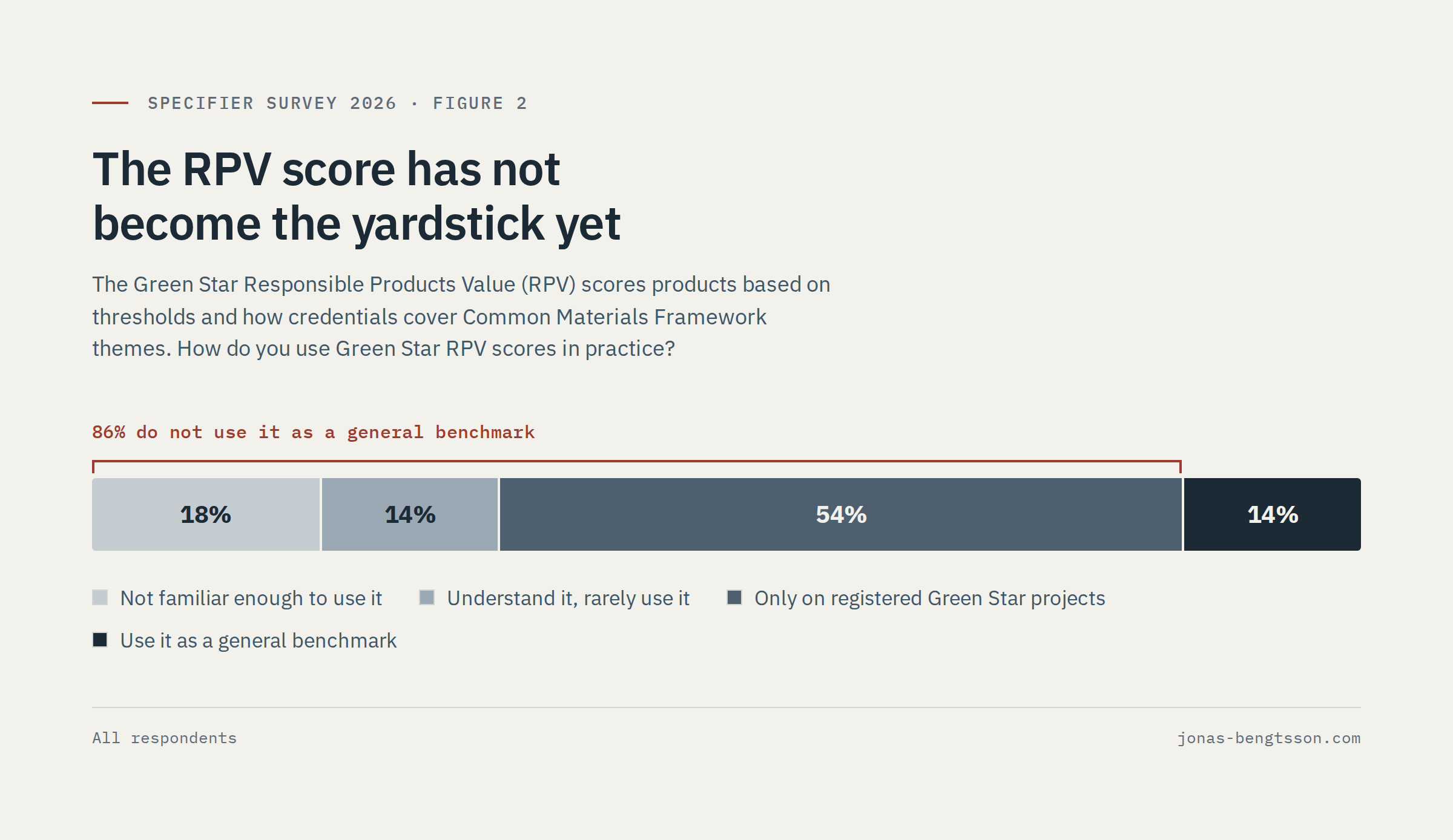
Green Star has aligned this market before, so I wanted to know whether the Responsible Products Value score was doing it again. 86% do not use it as a general benchmark outside Green Star. Of the 14% who do, most sit in engineering and sustainability consultancies, which is where I would expect it to take hold first.
RPV is doing the job it was designed for, on the projects it was designed for. A product optimised for RPV speaks clearly to the consultant on a rated project, and much less clearly to the architect choosing products on everything else.
Disclosure and certification answer different questions
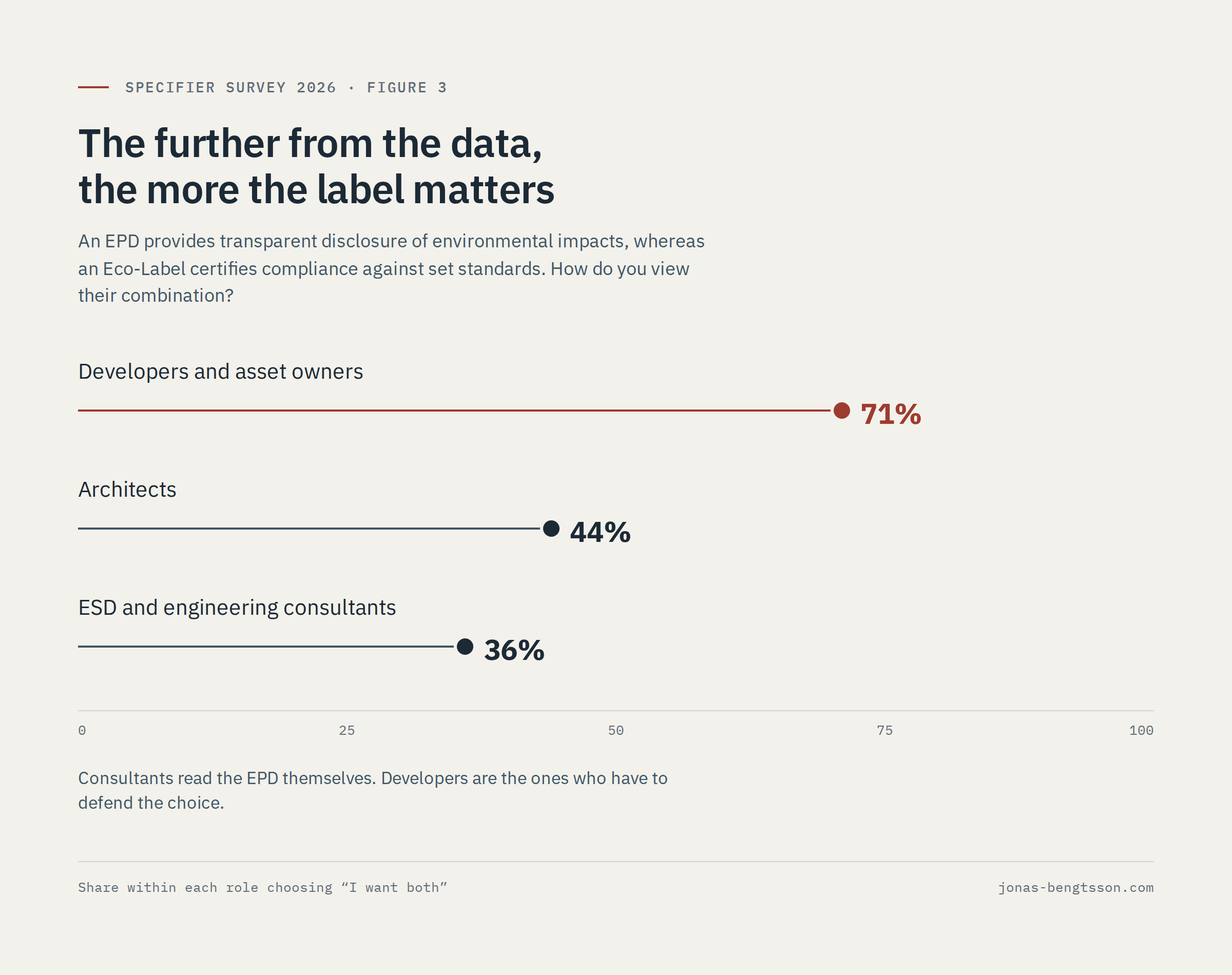
96% want the EPD data. Where they split is whether a certified eco-label changes the decision: 50% treat the EPD as the core and a label as a bonus, 46% see high value in both. The role split is the more useful number, and it means a supplier selling to a developer through an architect needs both answers ready.
Among those who want both, 85% point to circularity and 85% to material health. 54% name ethical sourcing and social impact, which surprised me as low.
The minimum credential moves with the product
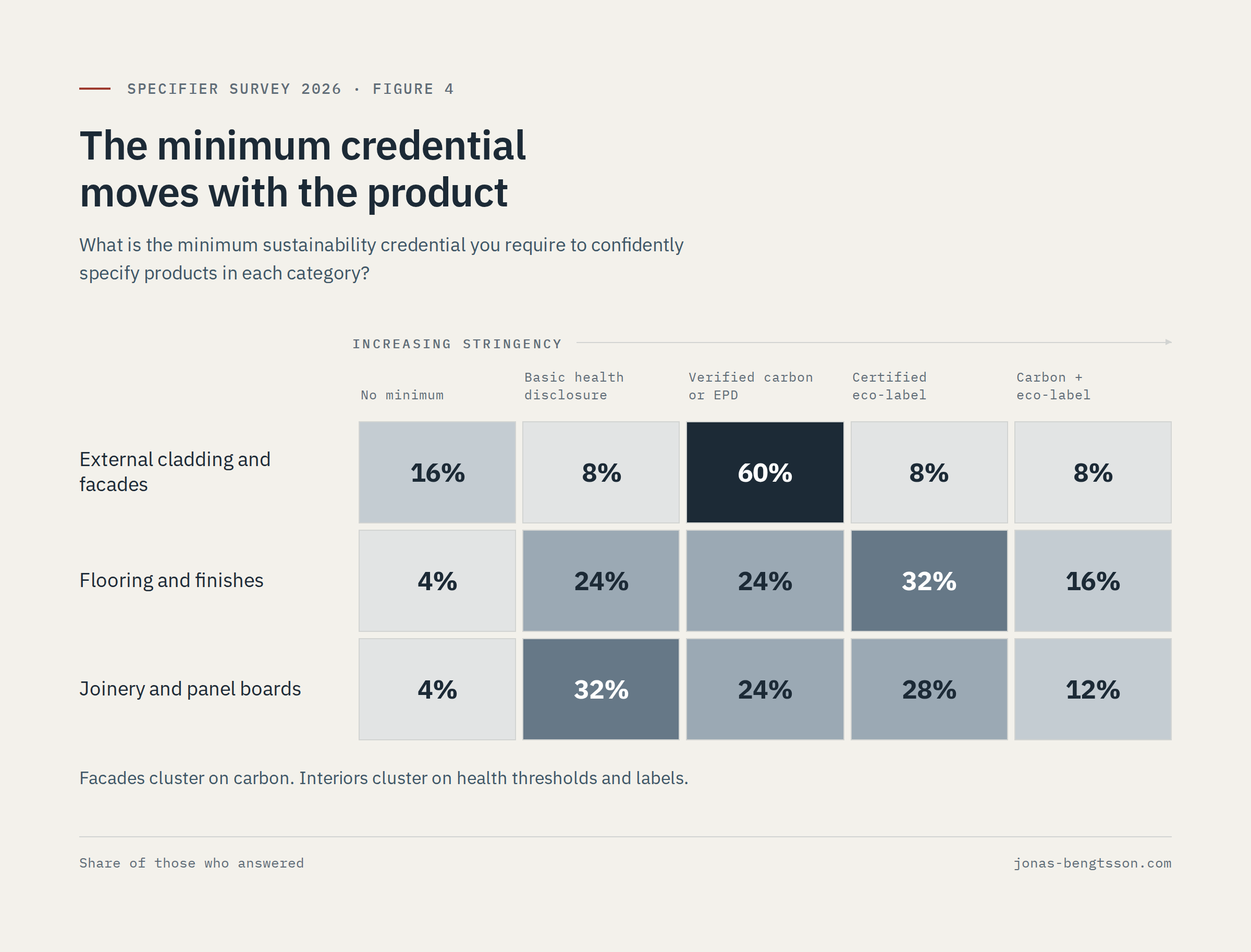
Outside the building the question is how much carbon. Inside, it becomes whether the product clears a health threshold, and a label answers that fastest.
The ten-minute rule
The most useful answer in the survey did not describe a credential, it described a search process.
“Stop making us jump through hoops to get access to your credentials. My rule of thumb, if I can't find something useful on a supplier or product after a 10 min google search, I'll stop looking. I generally have a list of products in my head I know I can trust, with verified certifications, that I will often tell an architect or a contractor to look at first.”
The specification decision is rarely a comparison across everything available. It is a shortlist, three to five names per category, held in someone's head and built out of past projects and search results. Certification gets you onto that list. Findability gets you considered for it.
The return on a credential is capped by how easily it can be found. An EPD nobody can locate in ten minutes is commercially an EPD that does not exist.
Method, and what I would not claim
Responses came in from 16 August 2026, from a list of over 150 people who select or approve building products, mostly Australian with the first New Zealand answers now arriving. Percentages are of those who answered each question. Most questions were forced choice, so people picked the closest match from a fixed list rather than describing their own process.
This is a pattern rather than a market measurement, and the role splits are indicative. No individual certification scheme is reported with its own percentage at this sample size.
One respondent pointed out, correctly, that bundling EPD and PCF into a single option hides a real difference between them. That will be split in the next round.
Is this survey legitimate?
Yes, and it is a fair question to ask of an unexpected email with a link in it.
The survey is run by me, Jonas Bengtsson, through Klar Advisory Pty Ltd (ABN 32 698 209 871), Sydney. I co-founded Edge Impact in 2008 and handed over the CEO role in early 2024, the year it was sold. The review and advisory work now runs through Klar. I am a certified LCA practitioner and an approved EPD verifier, and I sit on the UNEP Life Cycle Initiative Steering Committee.
If you received an invitation and want to check it before clicking anything, the survey links on this page are the same ones. You can also reach me at jb@jonas-bengtsson.com or on LinkedIn.
Responses are reported in aggregate only. No individual or organisation is named without permission.