“Sustainability creds are procurement tick-a-box documents right now, until the end client needs a marketing story about their building and the PR team shoe horns sustainability back into the origin story.”
Manufacturer
That is one of the comments from two surveys I ran over August and September. The first asked architects, consultants and other specifiers what sustainability information they expect from a building product today. The second asked the manufacturers who make those products how the market looks from their side.
I wanted both because there is a gap between what the people who choose building products ask for and what the people who make them spend their money proving. In my experience, neither side can see across it clearly, so I asked the people I know, and kind of know, on both sides of it.
I have watched rating tools go through their full life cycle, certification schemes come and go, and industry trends rise and fall. All well intended, and over time they have moved our industry forward, but none of it has made the next building any easier to specify. Upfront embodied carbon, the RPV score, modern slavery and deforestation rules all arrived within a few years of each other, and each one widened the gap before it started to close.
Manufacturers competing to be greener and better is what our industry needs. Guessing what the market is asking for, and will ask for next, is the part that is inefficient, expensive and frustrating. This piece puts the two surveys side by side to take some of the guessing out.
From labels to data
Green product labels are older than most of the people now specifying with them. West Germany launched the Blue Angel in 1978 on a simple idea: find the best environmental performers in a product category, make them visible at the point of purchase, and let demand reward them. Nearly fifty years later the Ecolabel Index tracks 456 schemes across 199 countries, and Type 1 ecolabels still cover well under 1% of what the world buys. I wrote about why in Bluetooth for green products. The short version is that every scheme kept its own criteria, its own evidence and its own format, so the signal fragmented before it reached the buyer.
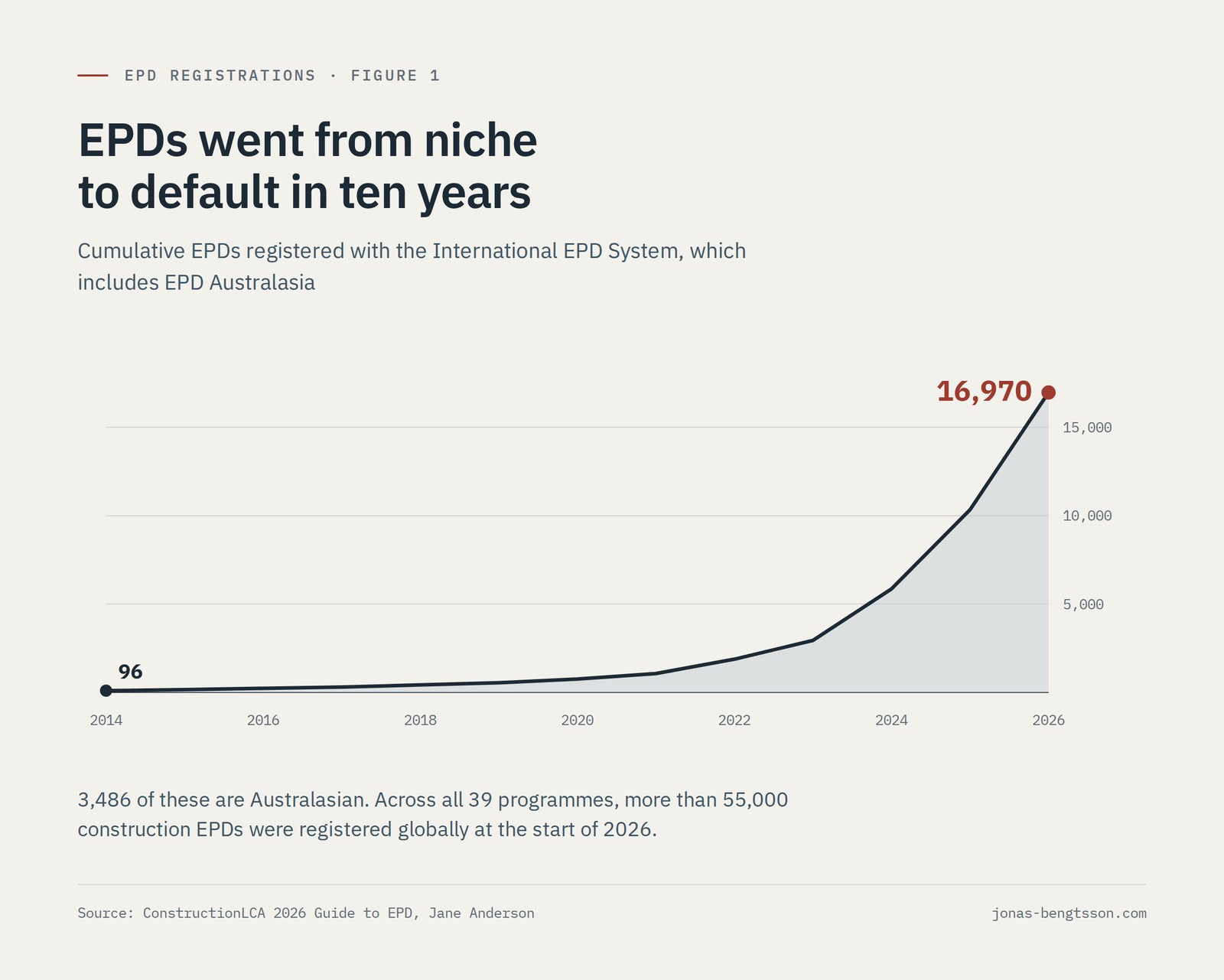
Construction took a different turn over the last decade. Instead of another label, the market asked for data. Environmental Product Declarations (EPDs) report a product's verified life cycle impacts without passing judgement on them, and they have gone from a niche to the default in about ten years. The International EPD System, which includes EPD Australasia, held 96 registered EPDs in 2014 and close to 17,000 at the start of 2026, of which 3,486 are Australasian. Across all 39 programmes, more than 55,000 construction EPDs were registered globally (ConstructionLCA 2026 Guide to EPD, Jane Anderson).
Data solved one problem and exposed the next. More labels have been added, the rating tools kept adding and evolving their own requirements, with procurement and specification guidelines on top. A manufacturer today can hold a certified label or verified EPD and still be asked to prove the same thing five different ways.
What specifiers ask for
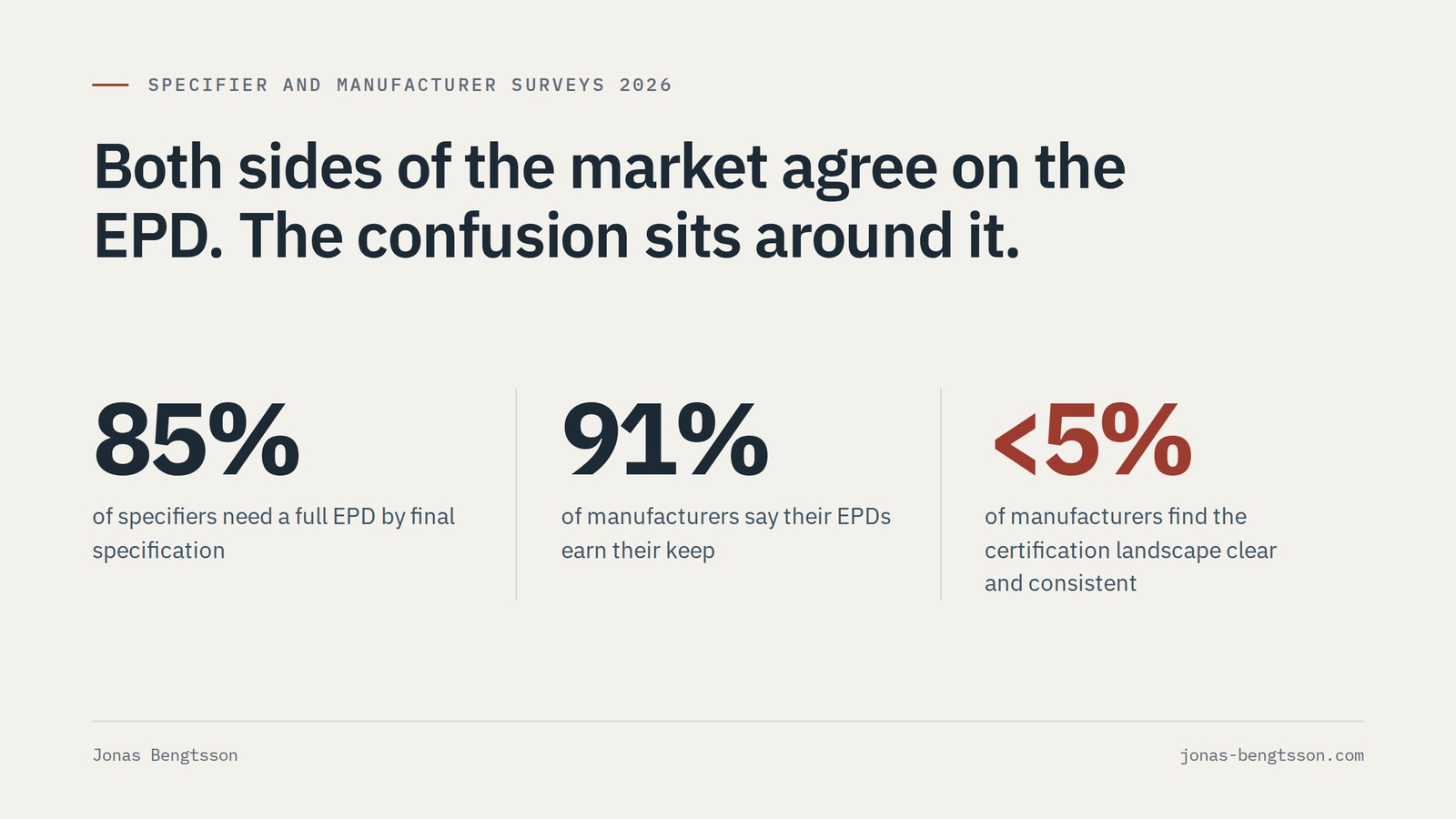
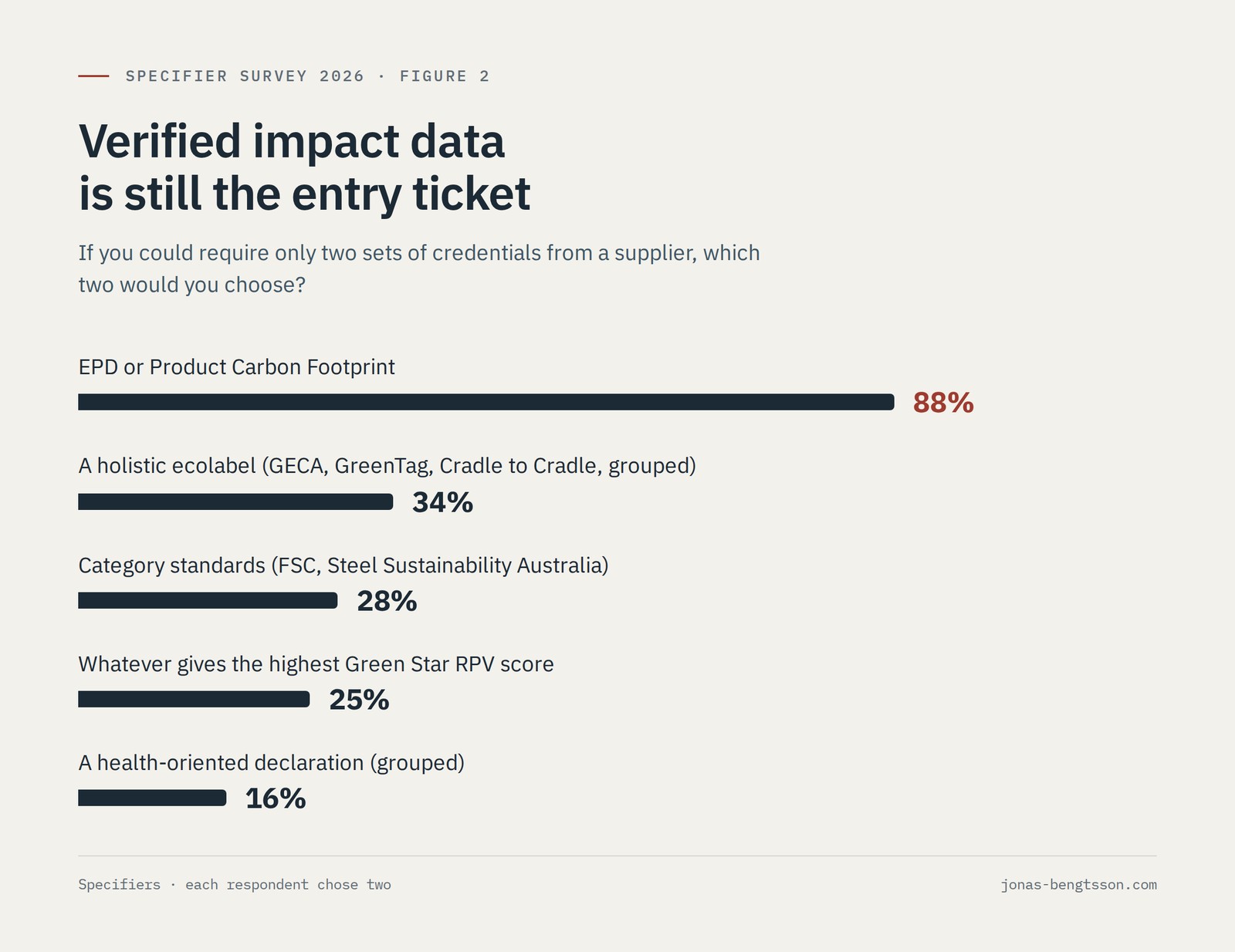
The specifier answers are clear on the core. 85% need a full EPD by the time a product is specified: 64% are happy with a Product Carbon Footprint (PCF) for early design comparisons as long as the full EPD arrives for final specification. Asked to require only two credentials from a supplier, 88% put an EPD or PCF in their top two, but only 6% say a carbon footprint on its own is enough, and those who explained why pointed to the missing life cycle stages and impact categories, not to distrust of the carbon number.
Above the EPD, agreement thins out. The holistic ecolabels as a group made the top two for 34%, category standards such as FSC for timber products and Steel Sustainability Australia 28%, whatever earns the highest Green Star Responsible Product Value (RPV) score 25%, and health-oriented declarations 16%.
Half want a certified label on top of the EPD, and half see the label as a nice bonus that rarely decides.
The rating tool sets the baseline, and most specifiers build their own rules on top of it. Only 6% simply align with Green Star. 42% use it as a common floor and look for suppliers who go further, 36% apply their own frameworks on projects that are not rated, and 15% set criteria brief by brief.
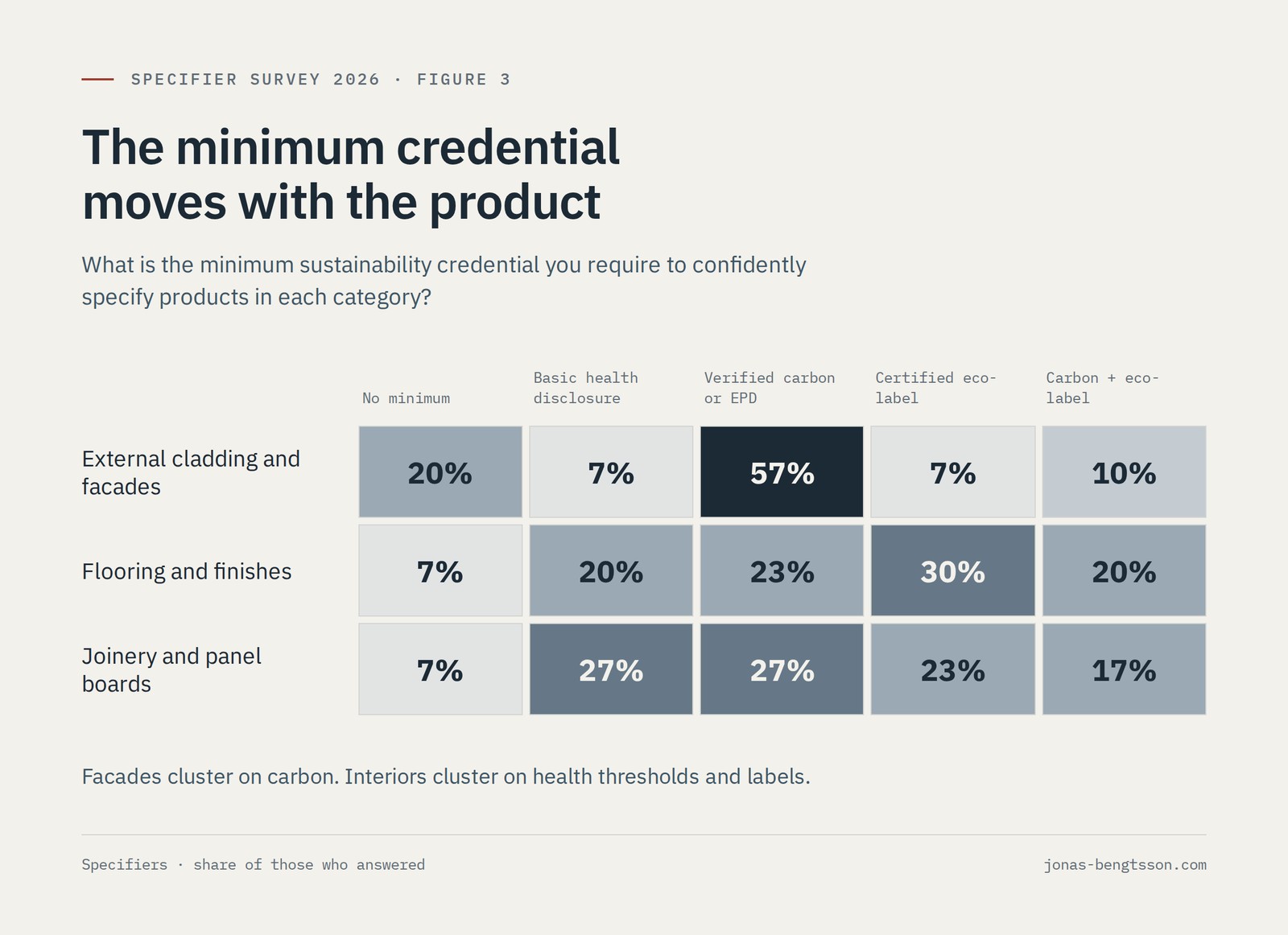
The ask also changes with the product. For external cladding and facades, 57% need verified carbon or an EPD as the minimum, and another 10% want carbon plus a label. For flooring and finishes, 70% ask for a health declaration, a label, or carbon and a label together, and joinery and panel boards look much the same at 67%.
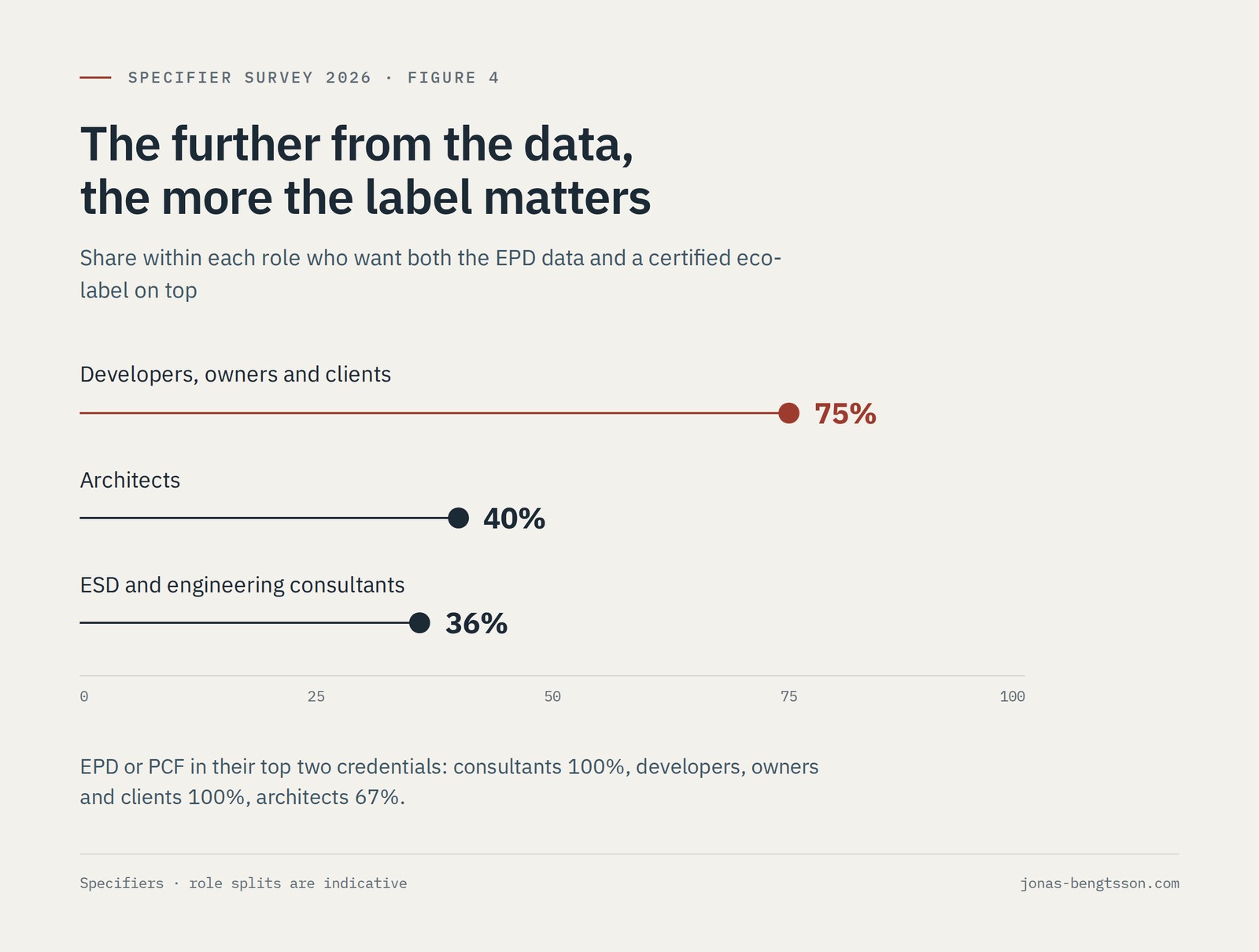
And it changes with the person asking. Every ESD and engineering consultant, and every developer, owner and client, put an EPD or PCF in their top two, against 67% of architects. 75% of developers and owners want a certified label on top of the EPD, compared with 40% of architects and 36% of consultants.
None of this is unreasonable. A facade engineer worried about upfront carbon, an interior architect worried about what people breathe for years, and a developer who has to defend the choice to a tenant are each asking the right question for their job. The difficulty is that the manufacturer has to answer all of them, for the same product, often on the same project, and against rating tools and procurement guidelines that describe similar requirements in different words.
That is the problem I have been working on with Klar Cite (launching soon): mapping what each scheme and guideline actually requires of a product, clause by clause, so that the same evidence can be read once and recognised wherever it counts.
What the manufacturers told me
I then reached out to my manufacturer network, mostly people I have worked with on EPDs over the years. Every manufacturer who answered already holds EPDs, so this is the view from companies that have made the investment, and it should be read that way.
On the EPD itself they are close to unanimous. 91% say their EPDs earn their keep. Asked which single credential has given the best return, 55% name the EPD, 18% a category standard such as FSC, PEFC or Steel Sustainability Australia, and 9% Declare. 82% can name a credential that has clearly paid back. If they were choosing today with the budget for one, 73% would fund a full EPD and 23% would start with a PCF.
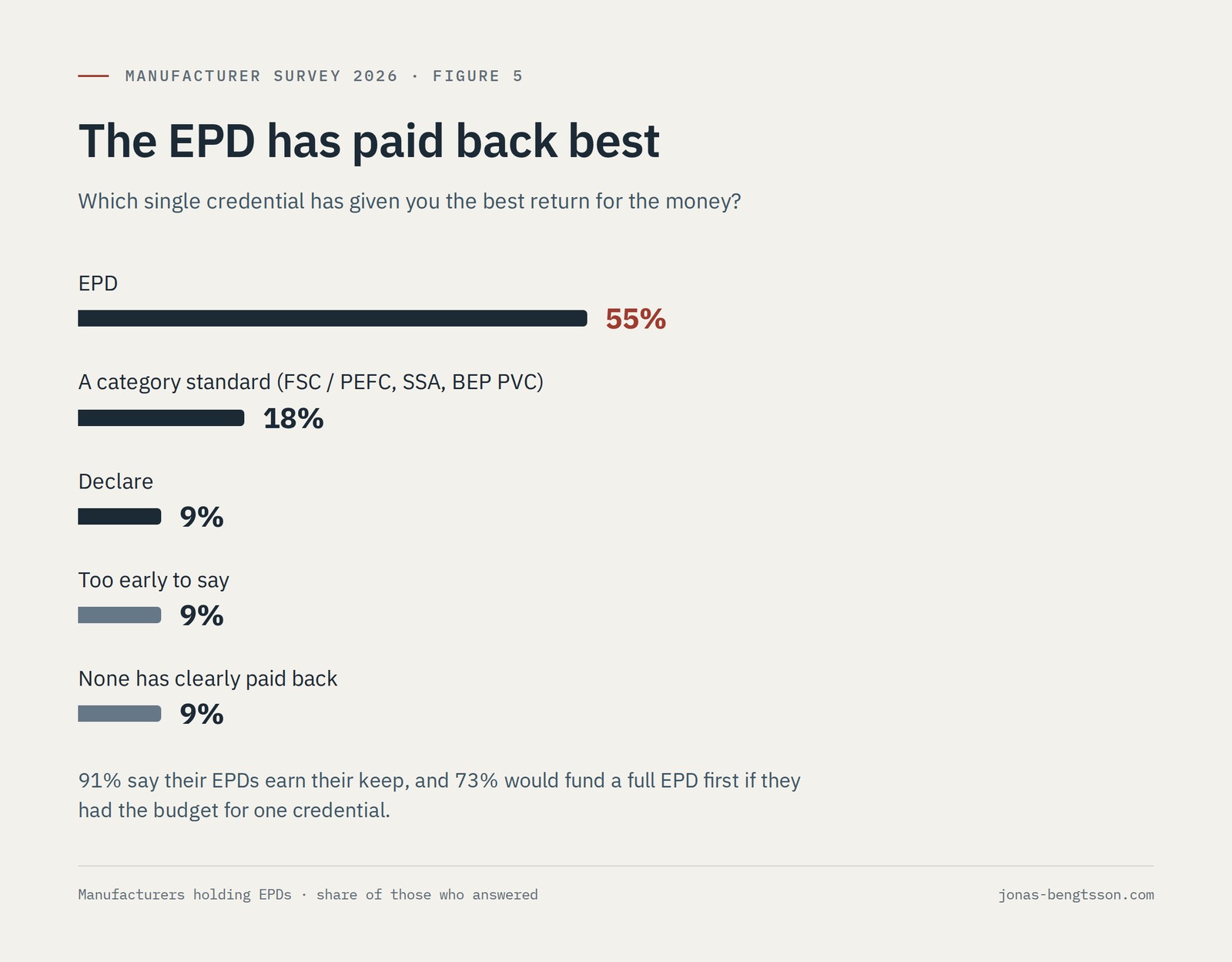
The 9% who question whether their EPDs are worth it point at cost, weighed against competitors relying on cheaper self-declared claims or against how few customers ask.
They also want what the specifiers want, a fair comparison:
“Make sure you are comparing apples for apples when comparing different products in the market.”
Manufacturer
“Eco-labels are a problem as well. They promote the brand, but not the standards that they rate to, so it confuses the market on like for like.”
Manufacturer
Where they part ways with the market is on how well lit the playing field is. Fewer than 5% find what the certification schemes require, and how they relate to each other, clear and consistent. 45% say it is mostly clear but keeps shifting, and 27% find it confusing. On what customers and rating tools want, half say it depends on the customer.
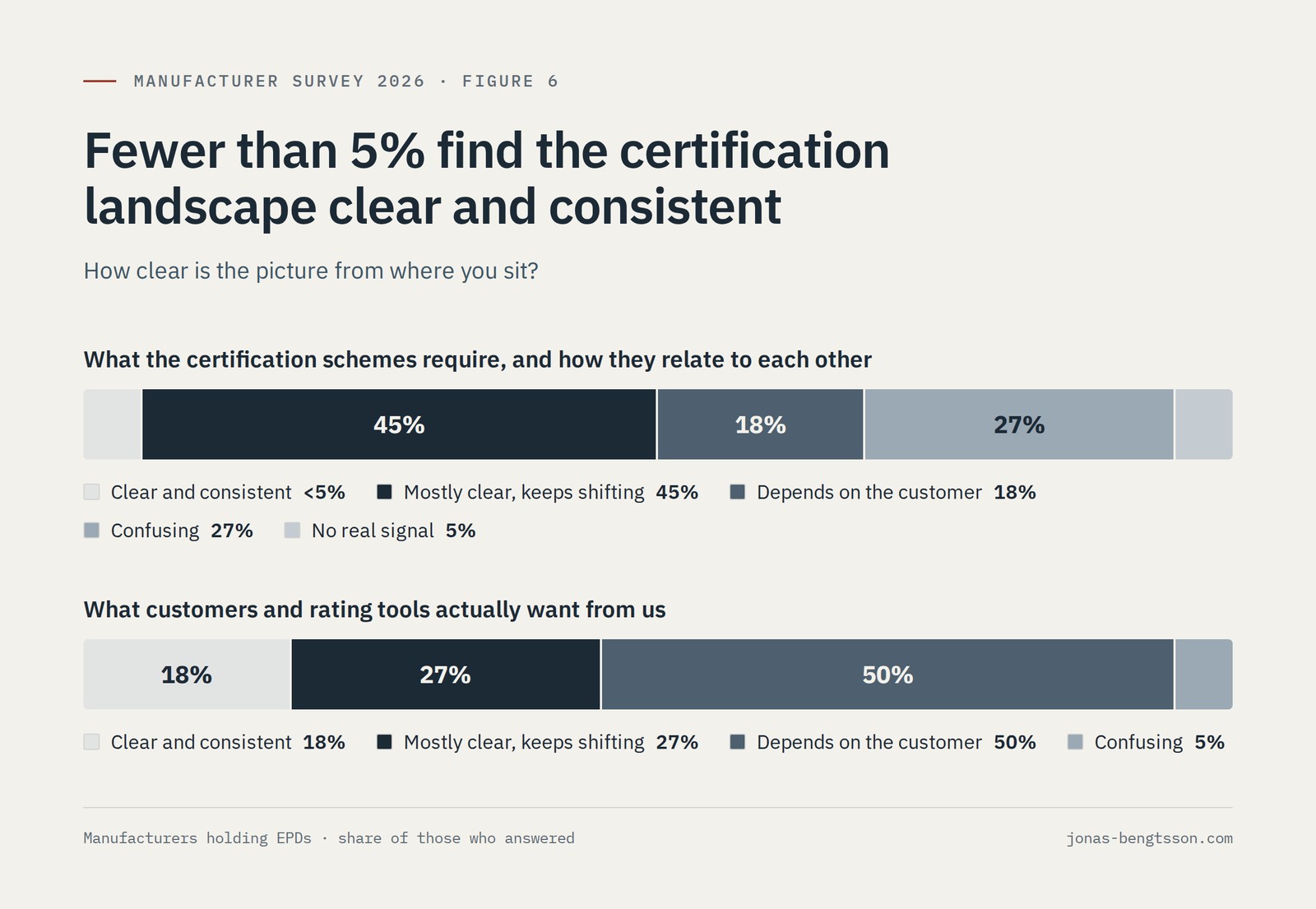
The specifier data says the manufacturers are reading the market accurately. It does depend on the customer.
The frustration that came through most clearly in the comments was about recognition. 35% of the manufacturer comments asked customers to use the credentials once they have them, in tenders, specifications and product selection:
“Request them from all suppliers and hold the specification (avoid substitution).”
Manufacturer
“Keep asking for them, ensure they are specified at a minimum requirement as part of tenders, and use the numbers as part of the tender selection.”
Manufacturer
“Avoid using default figures for traditional materials such as brick when lower carbon EPDs are available.”
Manufacturer
“Provide feedback about how our EPDs and other sustainably certified product information is actually being used by the customer, and what data points within are of value (we suspect it is mostly carbon).”
Manufacturer
Others put it more simply: "When will it be taken seriously?" and "Why doesn't sustainability matter more?"
My reading is that the effort is being made and the reward is uneven. A verified EPD that loses on price to a product carrying a default figure, or gets substituted out after specification, is a cost the manufacturer carries and the project never sees.
Where the two sides meet, and where they don't
Put side by side, the two surveys agree on more than I expected.
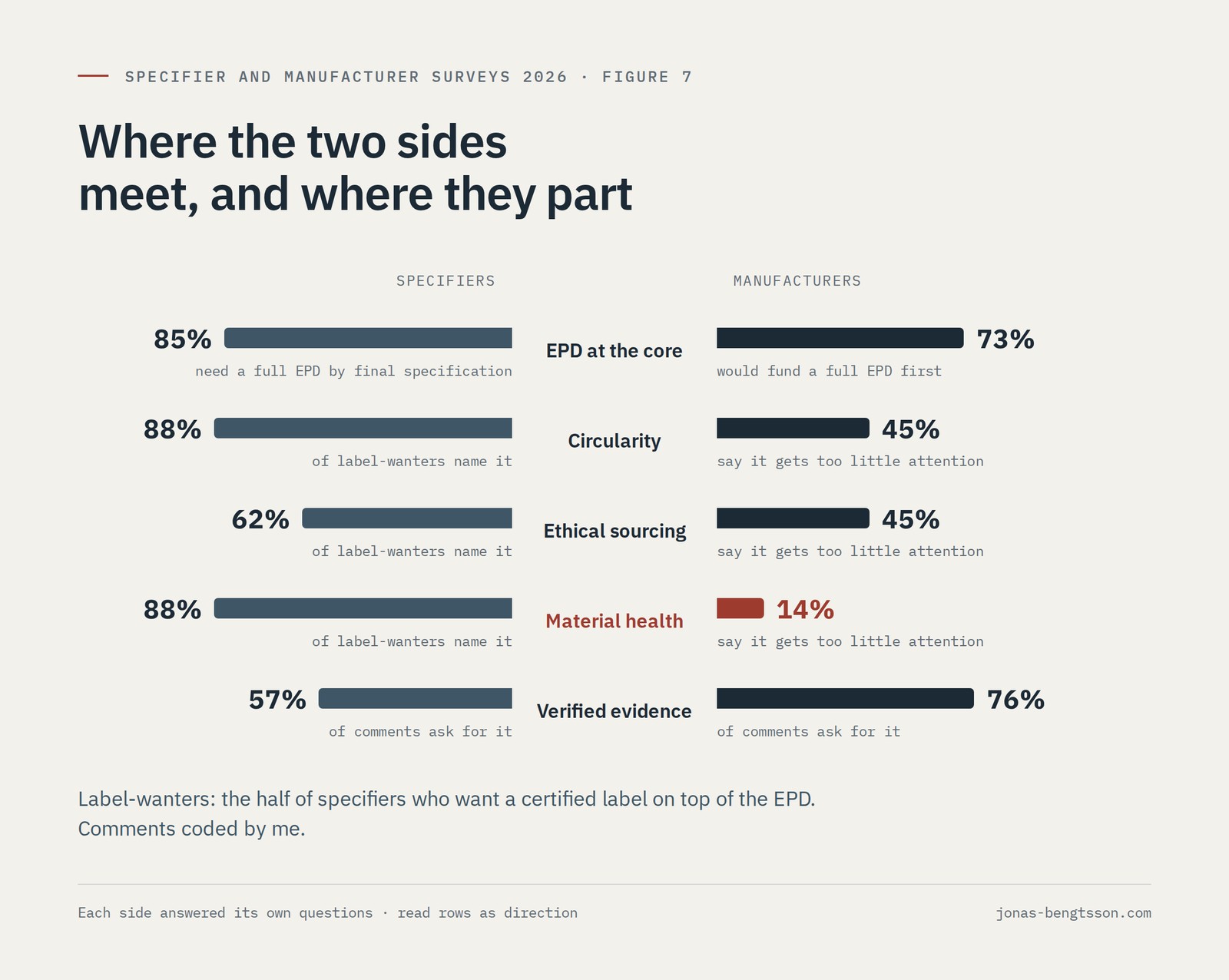
They agree the EPD is the core. 85% of specifiers need it by final specification, 91% of manufacturers say it earns its keep, and 73% would fund it first. The PCF question is less divisive than the industry conversation suggests. 23% of manufacturers would start with a PCF, which fits the 64% of specifiers who use a PCF early and want the EPD at specification.
They agree on what comes after carbon. Among specifiers who want a label on top of the EPD, 88% name circularity and 62% ethical sourcing. Among manufacturers, 45% say each gets too little attention. Embodied carbon itself gets the right attention or too little according to 77% of manufacturers, and nature and biodiversity is the clearest gap they see, with 55% saying it gets too little attention. I did not ask specifiers about nature, which in hindsight says something about where my own attention was.
They agree on evidence, and it matters to almost everyone. Verified evidence was the most common theme in the open comments on both sides. 57% of the specifier comments asked for verified evidence over marketing claims, or for credentials that are easier to find. 76% of the manufacturer comments asked customers to verify claims, compare like with like, or use the data in their decisions. Manufacturers were also the more likely of the two to name third-party verification explicitly, and the reason is in their comments: verified EPDs compete with self-declared claims that cost far less to produce.
“Ask for 3rd party verified credentials and do not limit just to carbon. There are far too many schemes accepting self-declared that is eroding the rigour of EPDs.”
Manufacturer
“Use third party standards to verify compliance, do not make motherhood statements on your website about being sustainable.”
Specifier
They part ways on material health and labels. Material health sits at the top of the specifier list alongside circularity, while more manufacturers think it gets too much attention (27%) than too little (14%). I checked whether product type explains it, and interior and envelope manufacturers answered much the same way. Labels show a similar gap: the half of specifiers who want a label on top of the EPD meet a supply side where 27% name a label or category standard as their best return. My reading is that this gap is where many label renewal decisions are being made right now, and material health is the one I most want to test in the next round.
A common language, in progress
The obvious answer to fragmentation is a shared structure, and the building industry is closer to one than most product sectors. The Common Materials Framework, curated by the non-profit mindful MATERIALS, sorts more than 150 product certifications, standards and labels into five impact areas: human health, climate health, ecosystem health, social health and equity, and circular economy. It describes what a credential covers without ranking it. In 2025 mindful MATERIALS closed its own product portal so it would not compete with the platforms it was trying to align, which I still think is one of the more generous decisions I have seen in this sector. In October 2025 the GBCA joined BRE, USGBC, IWBI, the International Living Future Institute and mindful MATERIALS in a global partnership to harmonise materials assessment across Green Star, BREEAM, LEED, WELL and the Living Building Challenge, with the Common Materials Framework as its foundation and a principles and metrics paper due in 2026.
Green Star already uses these categories in its Responsible Products framework, where a product's RPV reflects the credentials it holds and the impact areas they cover. The values move: in December 2025 the RPV for a product-specific EPD from EPD Australasia was raised from 5 to 7, applied retrospectively.
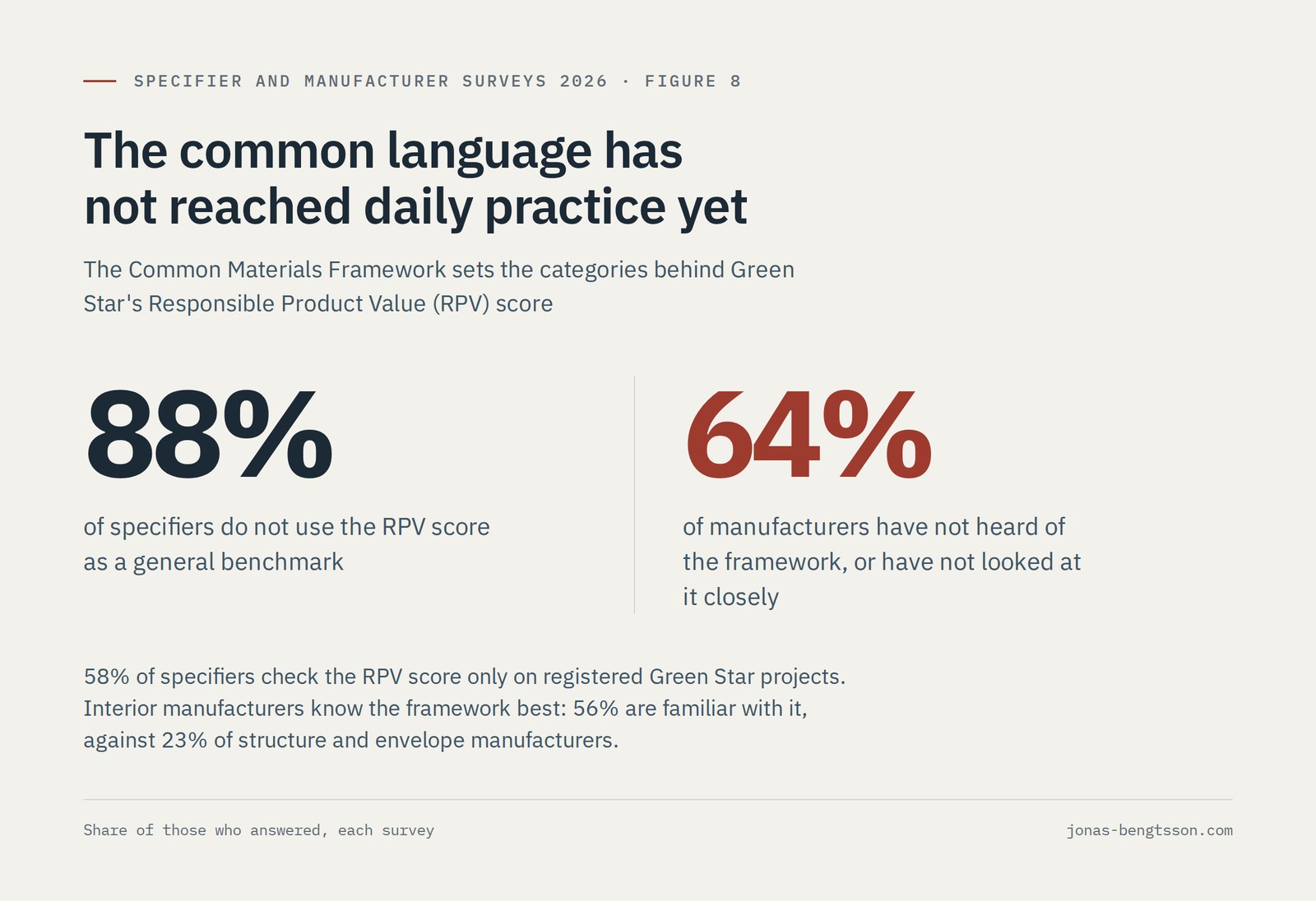
The survey shows how far this still has to travel. 88% of specifiers do not use the RPV score as a general benchmark, and 58% check it only on registered Green Star projects. On the manufacturer side, 64% have not heard of the Common Materials Framework or have not looked at it closely. Interior manufacturers know it best (56% familiar, against 23% of structure and envelope manufacturers), which fits a market where interiors are asked for labels and health.
I would like the framework to succeed, because a shared set of categories is exactly what would take the guessing out of this. Before it can do that job it has to reach the people choosing products on unrated projects, and the manufacturers of structural and envelope products. Adoption takes years, and we are early.
The market wants data, and the data is not yet ready to travel
The demand side has settled on data. 85% need the full EPD at specification, and the comments ask for numbers in place of adjectives:
“Stop using general motherhood statements and qualitative only marketing terms to pitch sustainability credentials, start using PCFs or EPDs for demonstrating measurable, comparable action.”
Specifier
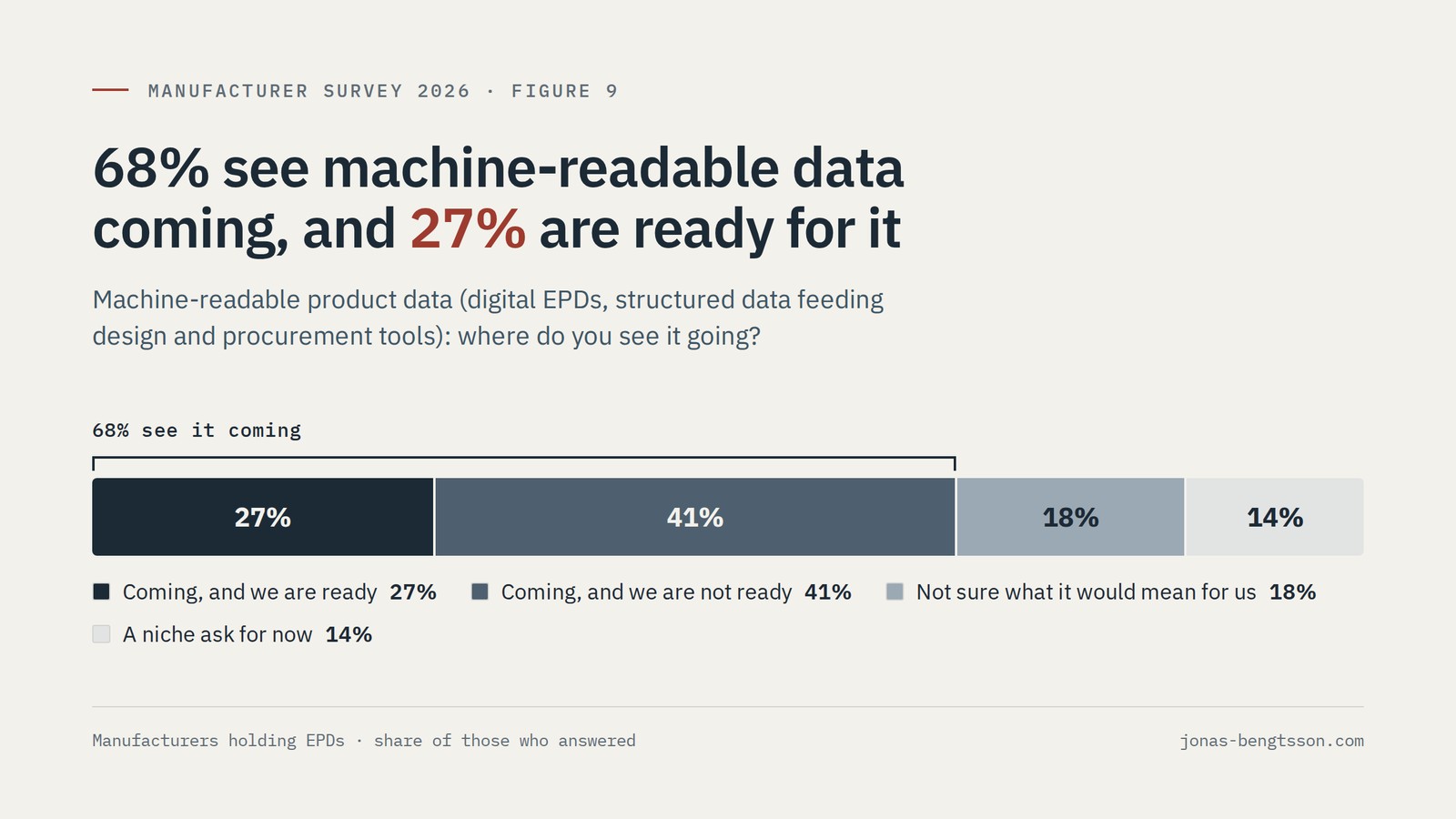
The next step is for that data to move on its own, into the design, procurement and assessment tools where products get compared. 68% of manufacturers see machine-readable product data coming. 27% say they are ready because their data already exists in structured form, and 41% say it is coming and they are not ready. The rest are unsure what it would mean for them (18%) or see it as a niche ask they will deal with when a customer requires it (14%).
This is the same gap I described in the Bluetooth piece, at a smaller scale. When the AI shopping protocols launched this year, they carried structured data for everything a machine can compare and no environmental fields at all. Building product data is further ahead than consumer goods, because the EPD already exists. It mostly lives in a PDF.
Easier to find, and easier to trust
The line I keep coming back to from the first write-up is a specifier's rule of thumb:
“If I can't find something useful on a supplier or product after a 10 min google search, I'll stop looking.”
Specifier
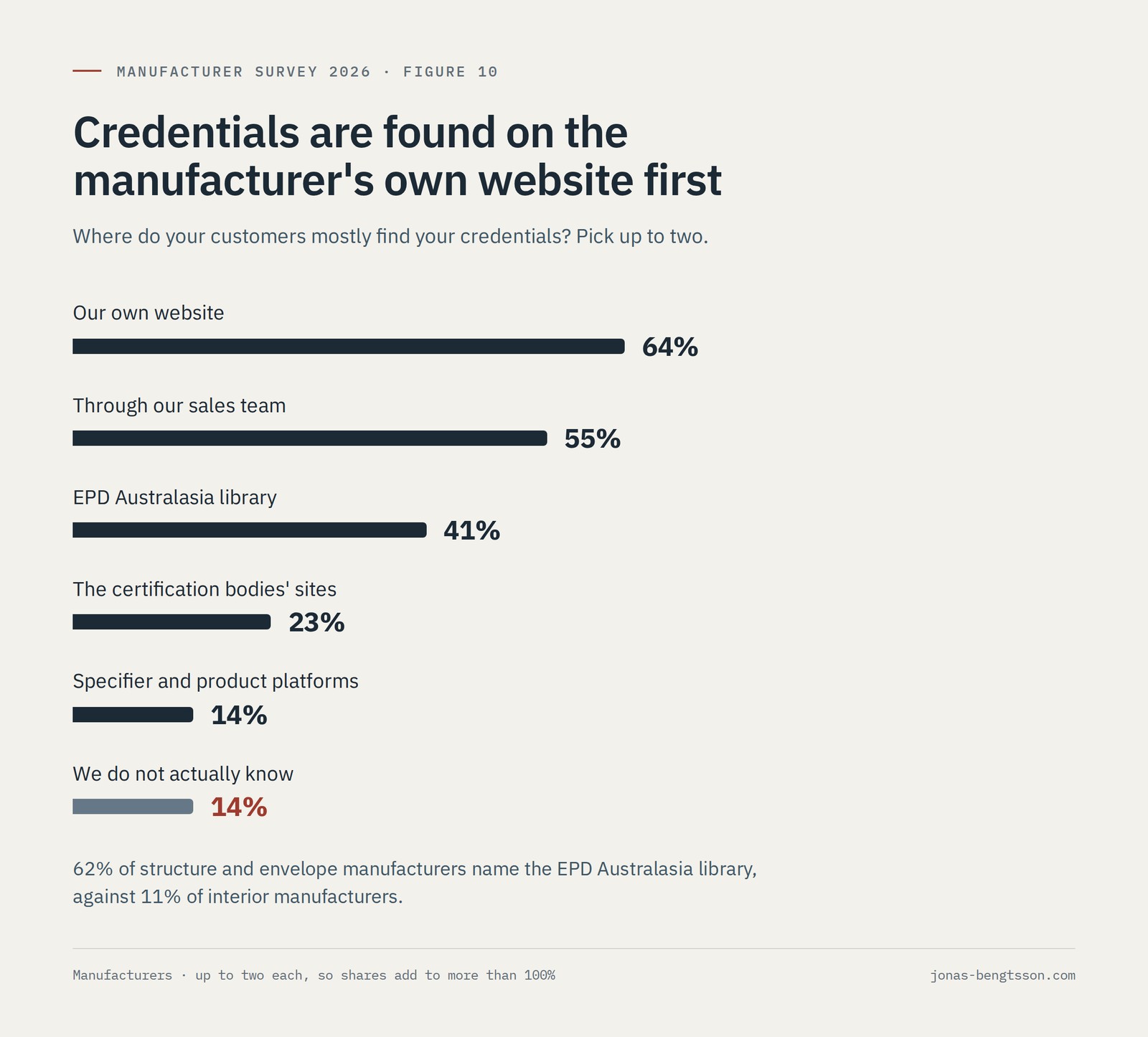
I asked manufacturers where their customers mostly find their credentials, and let them pick up to two channels, so the shares add up to more than 100%. The manufacturer's own website was named by 64%, the sales team by 55% and the EPD Australasia library by 41%, with certification bodies' sites at 23% and specifier platforms at 14%. 14% do not know where their customers look. The channels also split by product: 62% of structure and envelope manufacturers name the EPD Australasia library, against 11% of interior manufacturers.
Put the two sets of comments together and the handover is clear. Specifiers want the evidence easy to find and hard to fake. Manufacturers want it read, used and rewarded. Each side's ask depends on the other meeting theirs.
“The supplier should still host their EPDs and other RPV-relevant certificates online in an easy to access manner.”
Specifier
“Interrogate it and verify the claims that sit behind them. Challenge the methods and look at the science not the politics.”
Manufacturer
Where this leaves us
The EPD has become the shared language of this market. What sits around it will keep moving (it always has), and the industry is building the common framework that should make the rest legible. What I would suggest to both sides is smaller and closer to hand. For manufacturers, plan credentials by product category and by who reads them, and make the verified evidence findable in well under ten minutes. For specifiers, tell manufacturers what you actually use, hold the specification when substitution comes, and use the product-specific number when one exists.
My open question is who takes the next step of making the EPD travel as data, from the manufacturer's library into the tools where products get chosen, and whether we wait for a rating tool to require it first.
If your experience is different, I would rather hear it than keep a tidy picture. Both surveys are still open:
If you specify or approve building products: tally.so/r/eqOk4E
If you make them: tally.so/r/jaRkQ9
Method
The specifier survey ran from mid-August to mid-September 2026 and reached architects, ESD and engineering consultants, developers, asset owners, builders and government clients across Australia and New Zealand. The manufacturer survey ran through September 2026 and reached manufacturers in my network, all of whom hold EPDs; I grouped them as interior or structure and envelope based on what they make. Both were sent mostly through my own network, so neither is representative of the whole market, and both carry my blind spots. Percentages are of those answering each question. Most questions were forced choice. I coded the open comments myself, and one comment can carry more than one theme. Splits by role and product type rest on small groups and are indicative. Results are reported in aggregate only, and no person or company is named.